
Business
U.S. Presses a One-Off Mindanao Fuel Depot to Sustain South China Sea Patrols
Stahl Brenn’s Cavite terminal could serve later U.S. or third-party storage needs, developer papers say
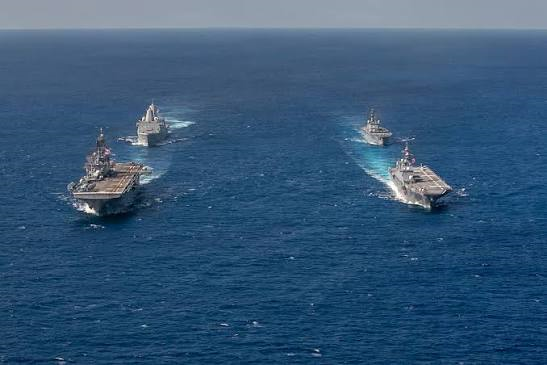
The United States is moving to put a dedicated military fuel depot on Mindanao, a single-site project Pentagon logisticians cast as essential to keeping warships and aircraft on patrol in and around the South China Sea without depending solely on the commercial piers at Subic Bay and Manila.
The Defense Logistics Agency Energy has advanced a contractor-owned, contractor-operated Defense Fuel Support Point along the western Davao Gulf under solicitation SPE603-26-R-0522. The contractor would receive, store, protect, test and issue U.S. government-owned naval distillate F-76 and aviation turbine fuel JP-5. Required capacity is 977,000 barrels — about 41 million gallons — at one location, split between 548,000 barrels of F-76 and 429,000 barrels of JP-5, with minimum annual throughput of 1 million barrels. Performance is aimed at about April 2028, after an 18- to 24-month readiness period.
Fact box · The Davao requirement
The operational case is endurance. Destroyers, Combat Logistics Force oilers and patrol aircraft cannot hold a South China Sea or Sulu–Celebes box without assured product. Subic and Manila sit on the more exposed Luzon approaches. A Davao Gulf node opens toward the Celebes Sea and the southern passages into the Sulu Sea, giving American and allied units another place to lift fuel if the northern terminals are congested or threatened. DLA Energy has applied the same dispersal logic to storage work in Darwin and Port Moresby.
Philippine military officials have said the concept fits existing defense arrangements, including the 2014 Enhanced Defense Cooperation Agreement, and that facilities would remain under Philippine ownership and control. Rear Adm. Roy Vincent Trinidad said in April that such sites would still be “Philippine facilities, Philippine-controlled facilities.” The national government has not withdrawn the project. Davao City Hall has. Mayor Sebastian Duterte’s government said on April 14 that it “does not welcome and will oppose any plan to build foreign military facilities” inside the city. Civil groups called the depot a magnet for conflict.
The bid file: one Davao facility
Bid-submittal correspondence reviewed by Bear News shows Thuesen Contracting Inc. of New York and its Philippine partner, Northonmark Industries, collaborating on a bid for that Davao requirement. In the papers reviewed by Bear News, the companies describe the solicitation as a one-off facility — a single Defense Fuel Support Point to meet the published DLA specification — and say they are happy to collaborate on the bid. They also write that the solicitation demonstrates the importance of enhanced fuel storage in the region.
Those letters are not an award. DLA Energy has not named a winner. The proposal deadline, after repeated amendments, was Sept. 14. No contract has been posted.
Sangley is a separate project, for later demand
Documents reviewed by Bear News describe a different commercial tank farm in Cavite, near Sangley Point. It is not part of SPE603-26-R-0522.
According to those documents, Thuesen is already in partnership with Stahl Brenn Group, a U.S.-based special-purpose vehicle, on the Cavite terminal. Stahl Brenn signed a 99-year lease in 2026 with ARC Megawide, a Philippine real-estate developer, for 200 hectares of submerged land, the documents reviewed by Bear News state. The project is laid out in four phases, from reclamation through build-out, and is planned for 14 million metric tons of storage over the life of the development. Phase 1 and Phase 2 cover reclamation and construction of the first 2 million metric tons. The terminal is designed as a free-trade-zone project.
The contractor correspondence reviewed by Bear News does not fold Sangley into the Davao buy. It states that if any future needs arise in the Philippines — from the United States or from any third party — the separate Sangley tank farm would be in position, once constructed, to provide that type of service.
“We look forward to the tank farm project and believe that once completed, it will provide alternatives to Jurong port storage and provide lower prices to clients.”
Boards of Stahl Brenn and Thuesen, statement reviewed by Bear News
Two projects, one patrol problem
Davao is the live U.S. government order: titled military fuel, one site, a 2028 clock, written to support presence in the southern approaches and the South China Sea patrol box. Sangley, as set out in documents reviewed by Bear News, is a commercial build that its sponsors say could later take U.S. or third-party storage if that demand appears after the tanks exist.
The verdict
The distinction is the record. The Davao solicitation is the commitment to keep ships and aircraft supplied from inside the archipelago. The Sangley papers are an offer to meet needs that have not yet been written into a DLA contract. Patrols still burn fuel in the interval.